Ramsay.
Health.Care.

Digital Transformation
Global Experience Language
2024.2025.

My Role.
Lead Product Designer
Lead UX/UI Design | Product Design | User Research | Design Strategy | Content Strategy |
Governance Rules | User Testing
-
What began as a Senior UX Design role focused on human-centred design within agile healthcare teams evolved into a strategic leadership position.
I led the digital expression of the Ramsay brand, shaping and evolving its visual and experiential identity across every digital touchpoint.
I drove the integration of design systems, multi-channel UX strategy, art direction, and content cohesion to deliver a seamless and elevated customer experience.
My work ensured Ramsay's digital presence not only reflected the brand but advanced it, combining precision, empathy, and consistency at scale.
-
Led the Ramsay Digital Design System, translating brand guidelines into scalable, user-facing digital assets as part of the Ramsay Global Experience Language (GEL).
Defined and evolved the design system architecture across Design Tokens, Atoms, Molecules, Organisms, Templates, Pages, and the broader digital ecosystem, creating a scalable foundation for consistent product development.
Provided art direction and visual design leadership, ensuring every digital touchpoint remained on-brand, accessible, and visually cohesive.
Designed for a multi-channel ecosystem spanning web, email, and patient portals, delivering a seamless and consistent brand experience across platforms.
Established governance frameworks covering naming conventions and taxonomy, accessibility and compliance, brand consistency, documentation, education, contribution workflows, design reviews, and tooling distribution to ensure long-term scalability and adoption.
Influenced UX content strategy by aligning messaging with user journeys and Ramsay's brand voice, creating clearer and more engaging digital experiences.
Led the digital expression of the Ramsay brand by integrating design systems, multi-channel UX strategy, art direction, and content alignment to deliver a cohesive, scalable, and elevated customer experience.
-
Figma
(Design Systems, Prototyping)Miro
(Workshops & Discovery)Adobe Illustrator
Adobe Photoshop
Askable
(User Research & Testing)

Hypothesis
We believed that redesigning the Information Architecture (IA) and aligning it with the Ramsay Global Experience Language (GEL), supported by a scalable governance model and unified design system, would:
Make it easier for users to find relevant content and complete key tasks, such as finding a hospital, specialist, or service.
Deliver a more consistent, intuitive, and trustworthy experience across all Ramsay digital touchpoints.
Improve operational efficiency by enabling teams to create, manage, and govern content more effectively.
Increase user engagement, satisfaction, and trust through clearer navigation, stronger information hierarchy, and a more cohesive digital experience.
-
We measured success through:
Improved task completion rates during usability testing.
Reduced user drop-off across critical customer journeys.
Positive qualitative feedback from users and stakeholders.
More efficient publishing workflows and clearer content ownership across teams.
Greater consistency in the application of the Ramsay Design System and Information Architecture across digital products.
-
Information Architecture, Design Concepts & Foundations.
This work stream supported Ramsay’s digital transformation by aligning Information Architecture (IA), design direction, and governance foundations with the Ramsay Global Experience Language (GEL). The goal was to create a scalable digital experience that improved consistency, usability, and content management across customer touchpoints.
The project focused on evolving Ramsay’s digital ecosystem through:
Aligning web strategy with business objectives and customer needs.
Defining user goals and priority journeys across corporate and hospital websites.
Redesigning and validating the Information Architecture, including navigation, content hierarchy, and utility structures.
Conducting IA testing to improve findability, terminology, and user confidence.
Creating two future-state website concepts, including shared navigation, homepage designs, and supporting content pages.
Delivering interactive Figma prototypes to support validation, stakeholder alignment, and future experience planning.
-
To create a unified, scalable digital experience aligned with the Ramsay Global Experience Language (GEL), we redesigned the Information Architecture, digital experience framework, and visual design system to better support user needs, business objectives, and future growth.
-
We developed a simplified, user-centred Information Architecture that reflected real customer goals and behaviours. By consolidating content structures and introducing a shared navigation model across corporate and hospital websites, we improved content findability, reduced duplication, and created a clearer pathway through Ramsay’s digital ecosystem.
-
We transformed the Ramsay brand into a digital-first design language through the creation of a scalable design system. This included reusable components, consistent visual patterns, accessibility considerations, and clear governance guidelines to ensure cohesive, on-brand experiences across all digital touchpoints, including websites, portals, email, and future digital products.
-
New page templates, interaction patterns, and content structures were introduced to support key user journeys, including:
Finding a hospital or healthcare service.
Booking an appointment.
Understanding treatments and available services.
Accessing quality and safety information.
Connecting with the appropriate team or healthcare professional.
These experiences were validated through IA testing, user feedback, and interactive prototyping to ensure navigation and content pathways aligned with user expectations.
-
Two future-state digital concepts were developed, each exploring a different vision for the Ramsay digital ecosystem while maintaining alignment with the GEL framework.
Interactive Figma prototypes enabled stakeholder collaboration, usability validation, and alignment on the future digital experience direction.
-
The redesigned experience established a stronger foundation for Ramsay’s digital transformation by:
Improving content discoverability, usability, and user confidence.
Creating a consistent brand experience across digital channels and regions.
Reducing content complexity and internal maintenance effort.
Enabling faster adoption of the GEL system across new digital experiences.
Improving accessibility, consistency, and trust throughout the customer journey.
Design Principles
The Ramsay digital experience was guided by principles that balanced user needs, brand consistency, accessibility, and long-term scalability.
-
Designed around the needs of patients, families, and clinicians, prioritising empathy, clarity, and meaningful interactions over internal structures.
-
Simplified information and interactions to help users find what they need quickly, confidently, and with minimal friction.
-
Applied the Ramsay Global Experience Language (GEL) to create a consistent visual and interaction experience across corporate, hospital, and digital touchpoints.
-
Embedded accessibility into every experience, following WCAG 2.1 AA standards and designing inclusively across devices and user abilities.
-
Created modular design systems and content patterns that enabled local teams to maintain flexibility while aligning with the broader Ramsay brand.
-
Ensured every interaction reflected Ramsay’s values of trust, safety, and professional care through thoughtful content, structure, and visual design.
-
Built reusable systems, patterns, and governance models that could evolve, scale, and be maintained over time.
-
Used analytics, research, and testing insights to continuously improve experiences while balancing measurable outcomes with human needs and brand integrity.

Design System Deliverables
The Ramsay Global Experience Language (GEL) established a scalable foundation for consistent digital experiences through design foundations, reusable components, documentation, and governance.
-
Created the core design principles and tokens that defined the visual language, including:
Colour system and semantic styles
Typography hierarchy
Spacing and layout grids
Elevation, borders, and visual treatments
Motion guidelines
-
Developed reusable components and patterns to support consistent product delivery, including:
Buttons, inputs, forms, alerts, and notifications
Navigation patterns, menus, tabs, and breadcrumbs
Cards, lists, and content modules
Complex components such as headers, footers, search, tables, and workflows
-
Created scalable page structures to support key digital experiences:
Homepage and landing page templates
Content and detail page layouts
Service and profile experiences
Form and workflow patterns
-
Established guidelines to support adoption, consistency, and long-term scalability:
Component usage and design principles
Accessibility standards
Content and naming conventions
Contribution models and governance processes
Figma libraries, documentation, and release management
The GEL framework enabled Ramsay teams to design and deliver accessible, consistent, and scalable digital experiences across multiple channels.
-
![]()
Atoms Icons | Clinical Quality & Safety Results
-
![]()
Atoms Icons
-
![]()
The Brightline Project
-
![]()
The Northgrid Project
-
![]()
New List Item
-
![]()
New List Item
-
![]()
New List Item


Ways of Working
The GEL transformation was delivered through a collaborative, iterative approach that aligned design, technology, content, and business teams around a shared digital vision.
-
Cross-functional collaboration across UX, UI, development, content, marketing, and business stakeholders.
Discovery and validation through audits, workshops, user research, IA testing, and stakeholder feedback.
Iterative design cycles using Figma prototypes to explore concepts, test solutions, and refine experiences.
Design system governance through shared libraries, documentation, contribution models, and ongoing feedback loops.
Agile delivery practices to support continuous improvement, alignment, and scalable adoption across digital teams.
This approach ensured the GEL system evolved as a living product balancing user needs, business goals, technical feasibility, and long-term sustainability.
-
Ramsay Health Care’s digital ecosystem had evolved across multiple platforms, resulting in fragmented information architecture, inconsistent design patterns, and limited governance across corporate and hospital websites.
This created challenges for users navigating digital experiences, teams managing content, and the organisation scaling its digital presence. A unified foundation was required to align the digital ecosystem with the Ramsay Global Experience Language (GEL), improve key user journeys, and establish a scalable approach to design, content, and governance.
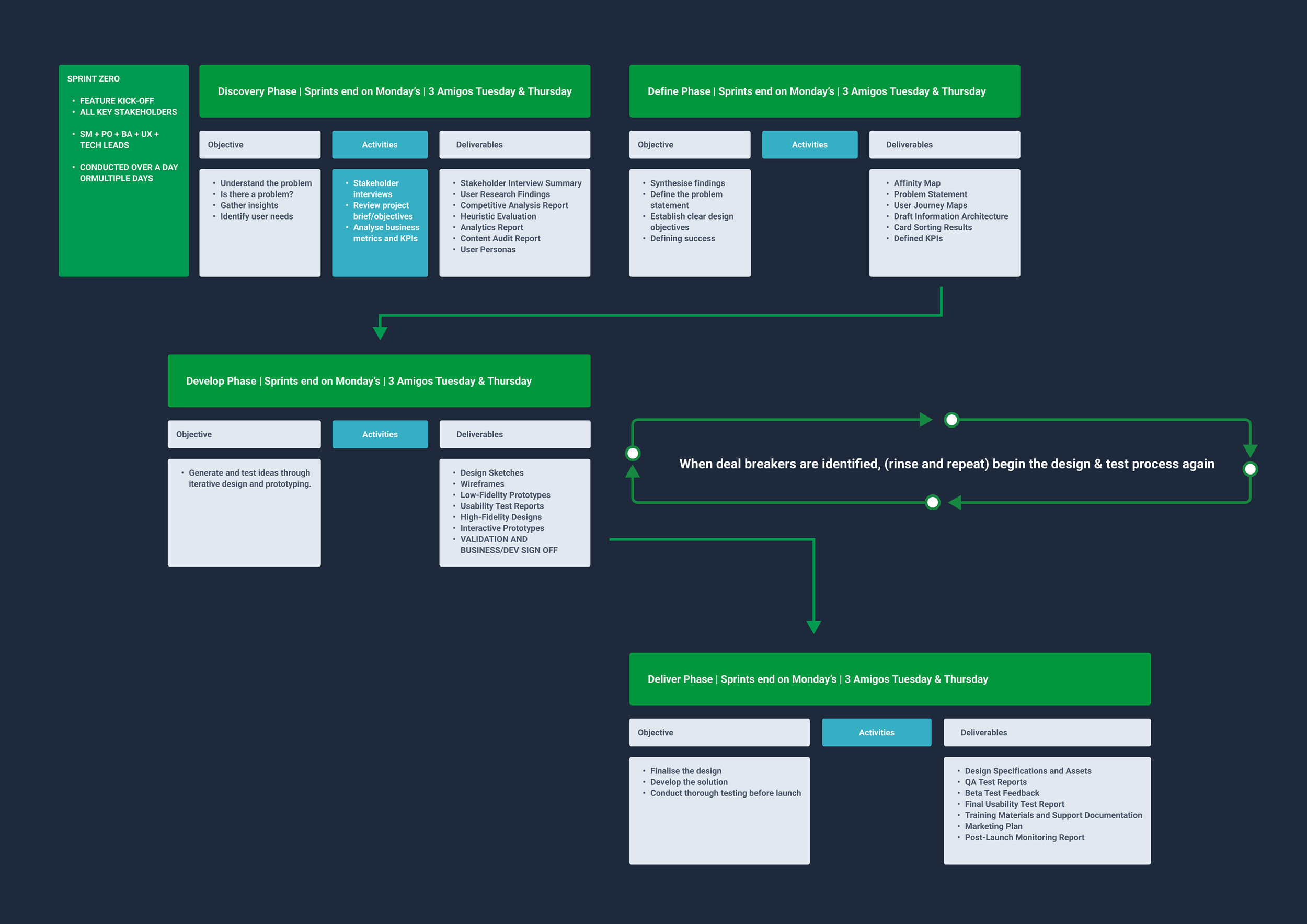
Current Journey: Key Pain Points
Ramsay’s digital ecosystem faced challenges caused by fragmented structures, inconsistent experiences, and limited governance across corporate and hospital websites.
-
Users struggled to find relevant hospital and healthcare information due to inconsistent navigation and content structures.
Important content was duplicated, difficult to locate, or buried within complex journeys.
-
Visual design, UX patterns, and content styles varied across digital properties, creating an inconsistent brand experience.
A lack of alignment with the Ramsay Global Experience Language (GEL) limited scalability and consistency.
-
Unclear ownership models resulted in inconsistent content management, approvals, and publishing processes.
Teams operated independently, creating challenges in maintaining a unified digital experience.
-
Key tasks, such as finding a specialist, locating a hospital, booking appointments, or understanding services, required unnecessary effort.
Existing structures did not fully reflect user needs or business priorities.
-
Managing and updating content across multiple hospital sites was inefficient and prone to inconsistency.
Limited testing and analytics made it difficult to identify opportunities for improvement and optimise user journeys.
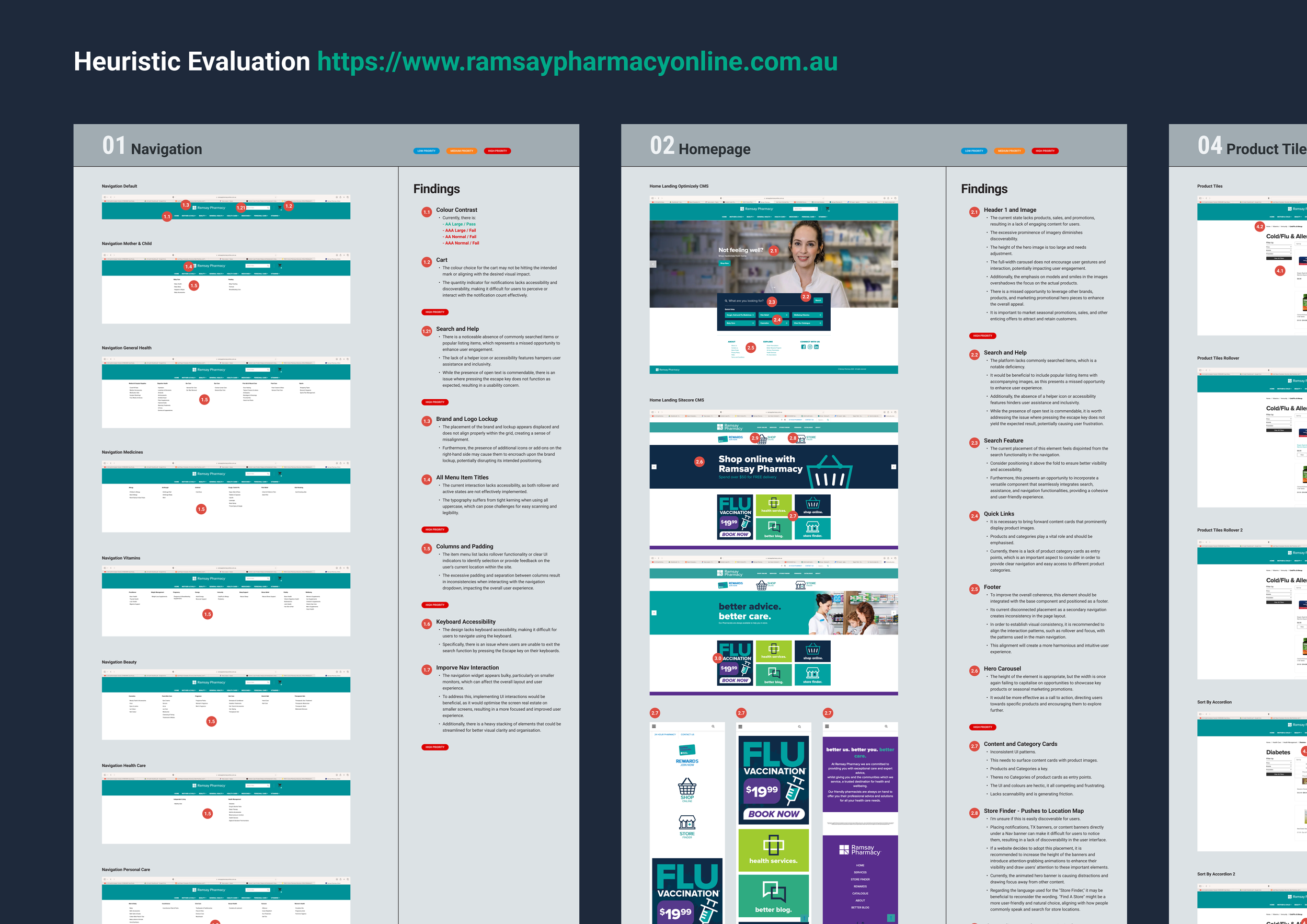
Constraints
The project involved several key constraints that influenced the approach and delivery.
-
IA redesign was prioritised before visual design, ensuring content structure, navigation, and user journeys were validated before developing the new experience.
-
All design decisions needed to align with accessibility standards, ensuring inclusive experiences across digital touchpoints.
-
Existing analytics, behavioural insights, and performance data were limited, requiring greater reliance on stakeholder knowledge, audits, IA testing, and qualitative validation to inform decisions.

The foundation of
the Ramsay Global Experience
2024.2025.

Tokens & Subatomic
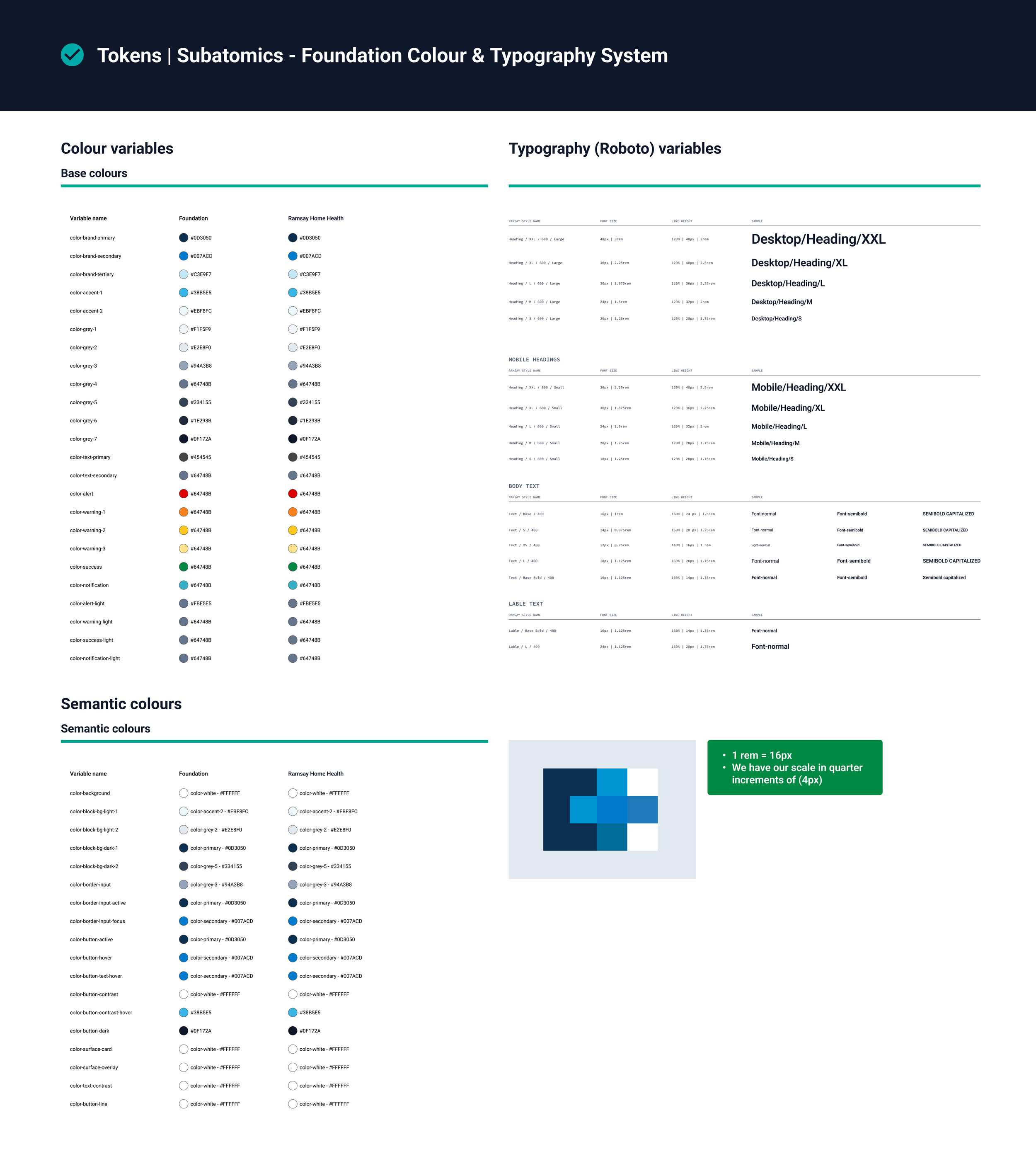
The foundation of the Ramsay Global Experience Language (GEL) was built through a structured system of design tokens and subatomic elements, creating a consistent visual language across all digital experiences.
-
Defined the core values that governed the design system, including:
Colour palettes and semantic colour roles
Typography scales and hierarchy
Spacing and sizing rules
Border, radius, and elevation styles
Grid and layout foundations
Motion principles
These tokens created a single source of truth, enabling consistency, scalability, and easier adoption across teams and platforms.
-
Established the smallest reusable building blocks that formed the basis of the component library, including:
Colours and typography styles
Icons and imagery guidelines
Form elements
Labels and states
Basic interaction patterns
These foundational elements provided the building blocks for creating reusable components, patterns, and consistent digital experiences across the Ramsay ecosystem.
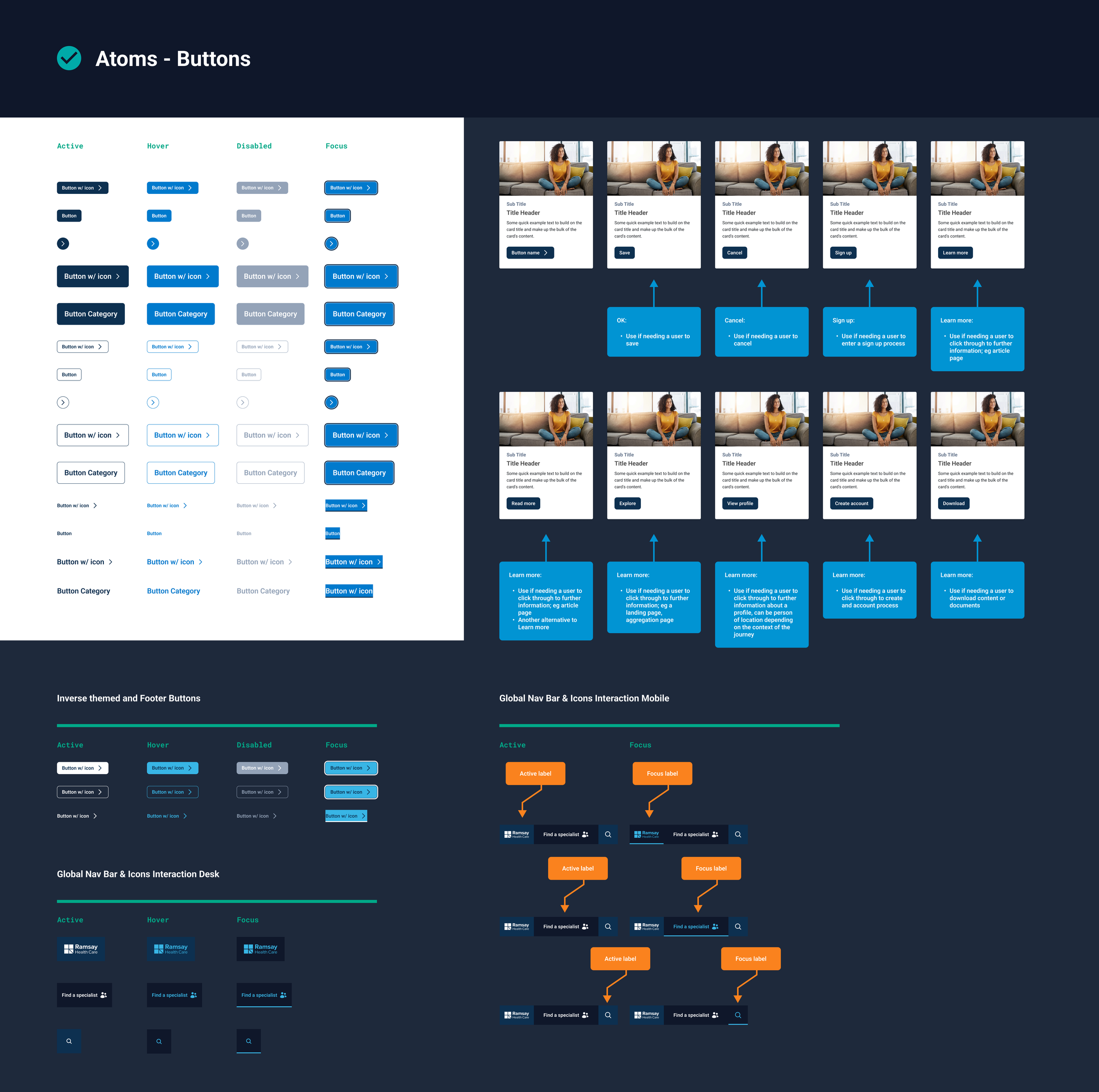
Atoms
Created the core UI building blocks of the design system, including buttons, inputs, icons, labels, typography, and form controls. These reusable elements established a consistent, accessible foundation for every digital experience across the Ramsay ecosystem.

Molecules
Combined subatomic elements into reusable interface patterns that solved common user interactions. These included form groups, search fields, navigation items, cards, alerts, and input combinations, creating consistent, accessible experiences while accelerating design and development across the Ramsay digital ecosystem.


Organisms
Combined multiple molecules into complete, reusable interface sections that supported key user journeys. Examples included headers, navigation, search, forms, tables, footers, and content modules, enabling consistent, scalable experiences across Ramsay’s digital products.
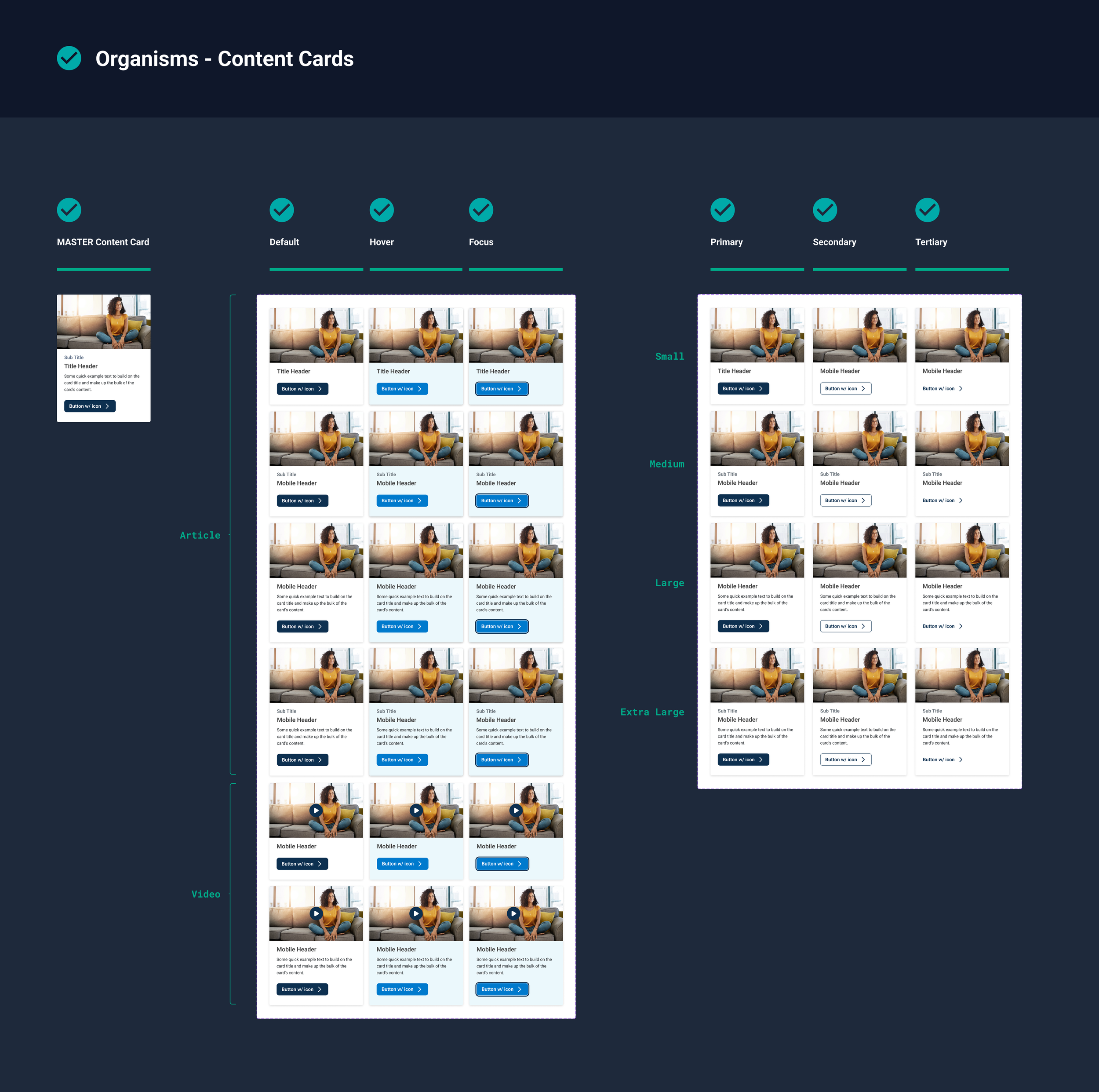
Templates
Developed reusable page layouts that combined organisms into consistent, scalable user experiences. Templates established the structure for key digital pages, ensuring design consistency, content flexibility, and efficient delivery across Ramsay’s digital ecosystem.

Pages
Applied templates, components, and real content to create complete digital experiences. Each page was designed to support specific user journeys while maintaining consistency, accessibility, and alignment with the Ramsay Global Experience Language (GEL) across the digital ecosystem.


Ecosystem:
Global with Secondary Theming
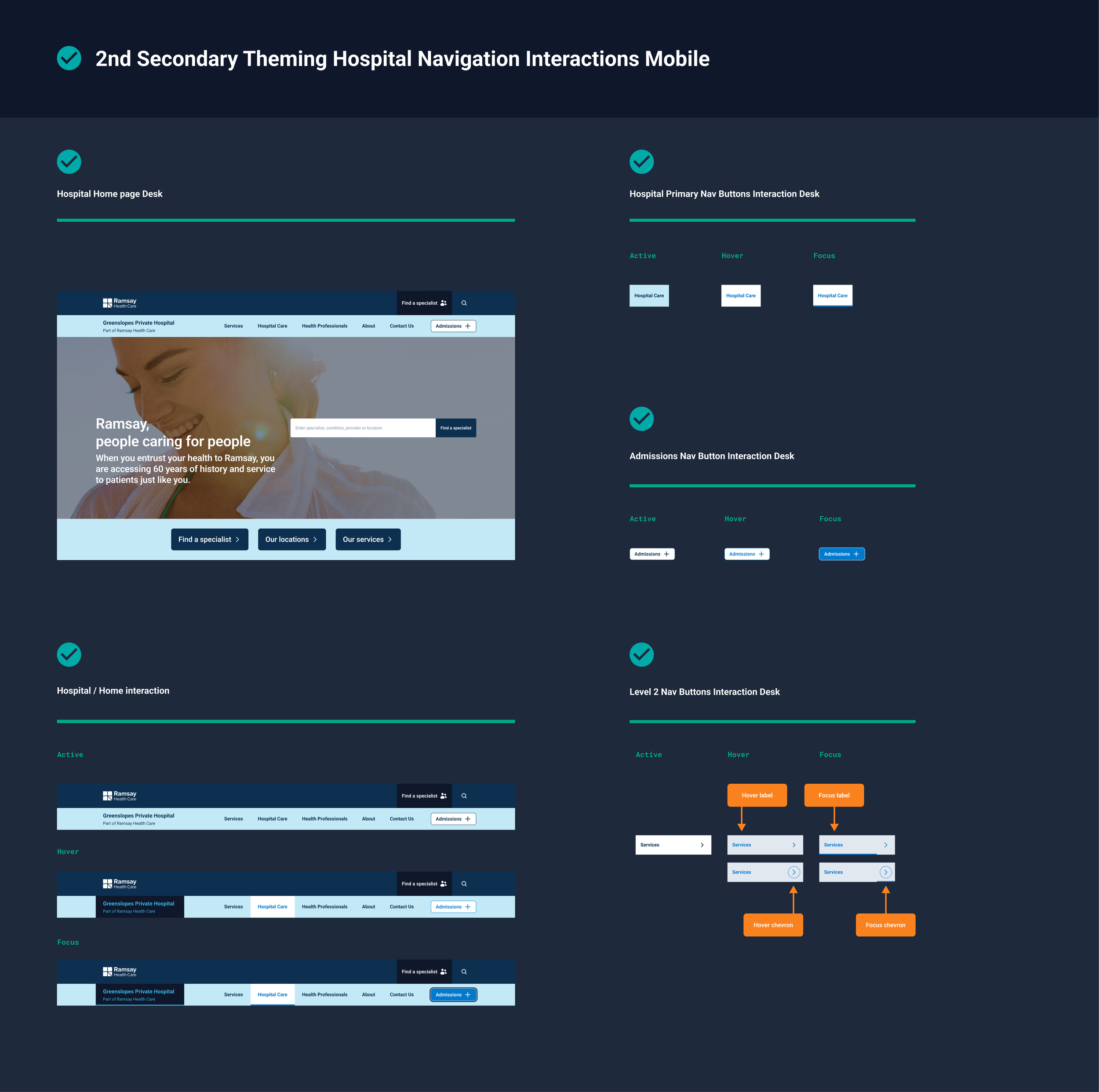
Established a unified global design system with flexible secondary theming, enabling corporate and hospital brands to maintain their individual identities while delivering a consistent, accessible, and cohesive user experience across the Ramsay digital ecosystem.
-
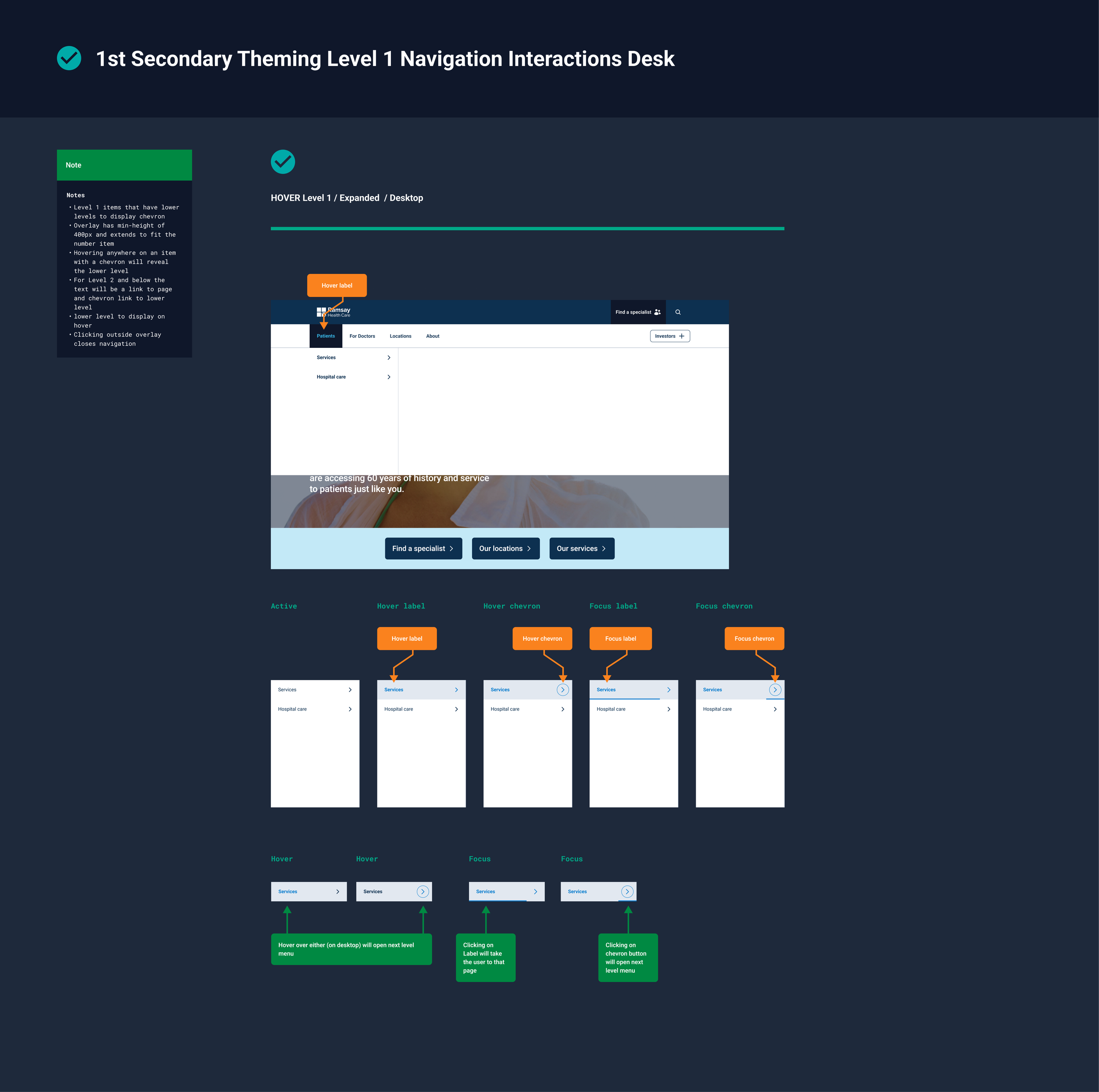
The navigation was redesigned to be consistent, intuitive, and predictable across the Ramsay digital ecosystem, enabling users to quickly find information and complete key tasks. A unified navigation structure, consistent page layouts, and reusable interaction patterns reduced cognitive load, improved orientation, and created a seamless experience across corporate and hospital websites.
-
Accessibility was embedded throughout the navigation framework to ensure an inclusive experience for all users. The solution aligned with WCAG standards and supported people with low vision, screen magnification users, and those who rely on spatial memory through consistent navigation patterns and page structures. The framework also remained flexible enough to accommodate evolving information architecture, sub-navigation, and future digital products while maintaining long-term scalability and accessibility.
-
Hospital content had evolved as a separate experience within the same website, creating inconsistent navigation, fragmented branding, and unnecessary complexity for users. To address this, we introduced a unified site architecture with a single global navigation, strengthening the connection between the Ramsay corporate and hospital brands while improving usability, accessibility, and consistency across the entire digital ecosystem.




Ecosystem:
Local with Secondary Theming
Ramsay's digital ecosystem lacked consistency across corporate and hospital websites, with fragmented Information Architecture, inconsistent design standards, and limited governance creating navigation challenges and operational inefficiencies. The solution introduced a unified Global Experience Language (GEL) with flexible secondary theming, enabling individual hospital brands to retain their identity while delivering a consistent, scalable, and customer-centred digital experience.
-
Unified Navigation
Established a single, consistent navigation framework across corporate and hospital websites, enabling users to find information quickly while creating a seamless experience throughout the Ramsay digital ecosystem.
-
Inclusive by Design
Embedded WCAG accessibility principles into navigation, layouts, and interaction patterns to create an inclusive experience for all users, while supporting long-term scalability and consistency.
-
One Website, One Experience
Although hospital content had historically been treated as a separate experience, it existed within the same website as the corporate site. We unified the navigation into a single global framework, strengthening the relationship between corporate and hospital brands while improving usability, accessibility, and user orientation across the ecosystem.


Metrics of Success
Success was measured across four key areas: User Experience, Design Consistency, Operational Efficiency, and Validation.
-
Improved completion of key user journeys, including finding hospitals, services, and specialists.
Reduced time required to locate important information.
Increased user satisfaction through UX feedback and survey insights.
Improved engagement across key digital touchpoints, including reduced bounce rates and improved NPS.
-
Increased adoption of the Ramsay Global Experience Language (GEL) across redesigned digital experiences.
Reduced duplication and inconsistency across hospital and corporate content.
Improved reuse of content patterns, components, and modules to increase efficiency.
-
Established a scalable web governance model with clear ownership, roles, workflows, and contribution processes.
Reduced content publishing errors and inconsistencies.
Improved speed and efficiency of content updates through clearer processes and reusable design patterns.
-
Successfully tested and refined Information Architecture through multiple validation cycles.
Achieved stakeholder alignment on navigation, content structure, and future-state design direction.
Delivered interactive Figma prototypes validated through stakeholder reviews and user feedback.
User Goals
Users needed a digital experience that was simple, trustworthy, and easy to navigate across Ramsay’s healthcare ecosystem.
-
Users wanted to easily locate hospitals, services, specialists, and health information through clear navigation, logical content structures, and effective search.
-
Users expected accurate, reliable healthcare information presented through a consistent and trustworthy brand experience.
-
Users needed a consistent experience across websites, mobile, email, and patient portals, with familiar patterns, messaging, and visual identity.
-
Clear pathways and calls-to-action helped users confidently complete tasks such as booking appointments, finding locations, or contacting the right team.
-
Users needed personalised hospital and service information relevant to their location and healthcare needs.
-
The experience needed to minimise unnecessary searching, clicks, and reliance on phone support by connecting users with the right information quickly.
Business Goals
& Opportunities
The transformation aimed to create a scalable, consistent, and customer-centred digital ecosystem that strengthened Ramsay’s brand, improved user engagement, and enabled operational efficiency.
-
Create a consistent digital experience through the Ramsay Global Experience Language (GEL), strengthening brand trust and recognition across all customer touchpoints.
Increase engagement and conversions by improving navigation, content relevance, and key user journeys such as service discovery, specialist searches, and appointment bookings.
Improve operational efficiency through reusable design patterns, scalable templates, improved Information Architecture, and streamlined content management.
Establish governance and scalability with clear ownership models, workflows, and frameworks to support future growth and digital evolution.
Improve discoverability and SEO through clearer content structures, metadata, and search-friendly experiences.
Support local and global needs by providing a flexible design foundation that enabled hospital teams to maintain local relevance while preserving overall consistency.
-
Differentiate Ramsay through digital experience by creating a modern, patient-focused healthcare ecosystem built on strong UX and design principles.
Use research and testing to optimise continuously by validating IA, navigation, and content decisions through user insights.
Consolidate fragmented digital experiences by reducing duplication, improving governance, and creating a unified platform approach.
Enable future personalisation through a scalable foundation that could support tailored experiences based on location, healthcare needs, and user context.
Reduce support demand by improving content clarity and findability, helping users access answers without relying on contact centres.
Conclusion
& Learnings
This work stream established a strong foundation for Ramsay’s digital transformation by unifying Information Architecture, design systems, and governance through the Global Experience Language (GEL).
By bringing corporate and hospital experiences into a single, cohesive framework, we improved consistency, accessibility, and scalability across Ramsay’s digital ecosystem. The introduction of a unified navigation model, validated IA, reusable design components, and governance practices created a foundation that balanced user needs, brand alignment, and business objectives.
-
Treating hospital and corporate content as one connected ecosystem improved navigation, strengthened brand alignment, and reduced user confusion.
-
Predictable navigation, layouts, and interaction patterns helped create more inclusive experiences for users with different abilities and assistive technologies.
-
Clear design system principles, reusable components, and ownership models ensured the experience could evolve sustainably across multiple digital channels.
-
IA testing, prototyping, and stakeholder validation provided the insights needed to refine user journeys and increase confidence in the future-state experience.
-
Translating Ramsay’s brand into a digital design language created a consistent, accessible, and scalable experience across all touchpoints.